How a Twincliff scaffold goes up: from survey to a signed inspection tag
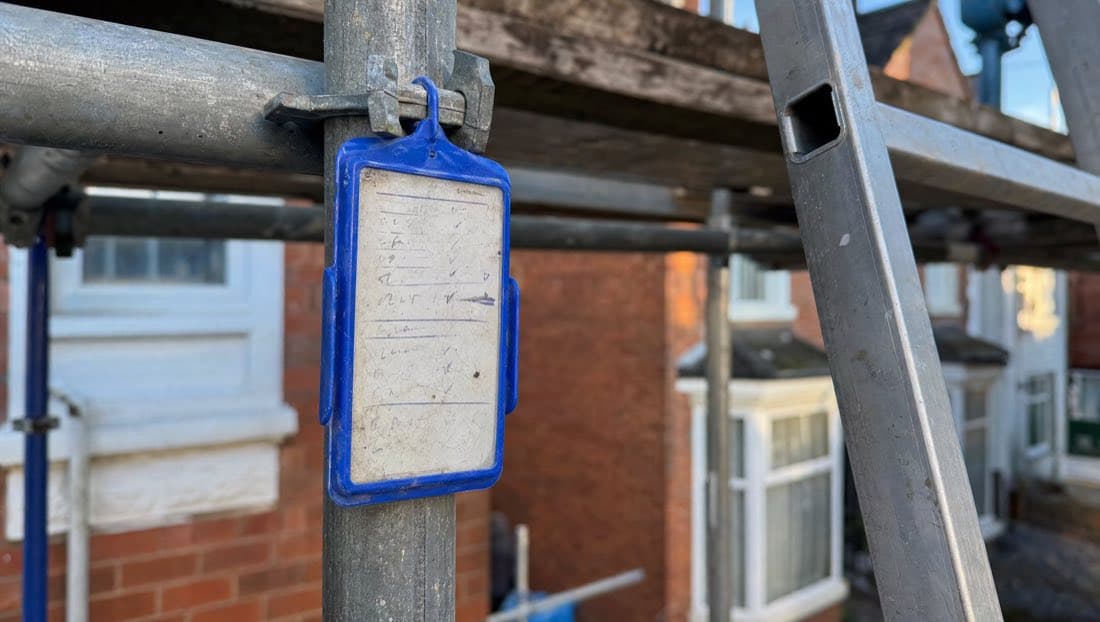
Five stages, one number, and a scaffold inspection tag on the standard that records when it was last inspected and found fit for use as built. What happens from the first call to the strike, and the questions we get asked most.
The five stages
- Survey. Our surveyor comes to site, measures the elevations, and checks what a photo cannot show: ground, ties, side access, overhead cables, the pavement, and where the loading bay sits. A temporary roof, a bridge over a conservatory or a chimney stack scaffold is decided here. Book it on the survey page.
- Price. One figure from what was measured. It covers the erect, the agreed hire, the planned adaptations and the dismantle. No price list, no figure from a photo.
- Erect. Our own crew puts it up on the day agreed. Standards, ledgers and transoms go in as surveyed, ties are set, boards and edge protection fitted, debris netting where the survey said so. Inspected, tagged, handed over.
- Adapt. Lifts added, moved or dropped as the job changes. A hop-up for the fascia, a loading bay when the steels are due, a top lift when the dormer goes on. Re-inspected, tag updated. Same number.
- Dismantle. Down and off site when you tell us, so the next trade can get in.
Reading the tag
The inspection tag is a holder fixed to a standard at the access point. Before your crew climbs, read the card. If it is not green, or the date is more than seven days old, ring the number on it. It is the same on every scaffold we hand over, from a domestic job to a small development.
FAQs
What does the tag on the scaffold mean, and is the scaffold safe to use?
The tag records the date of the last inspection and who carried it out. A green card means the scaffold was inspected on the date shown and found fit for use as built. A red card, or a holder with no green showing, means the scaffold is not to be used: it is still being built, being altered, or has failed inspection. If in doubt, do not climb. Ring the number on the tag.
Who inspects the scaffold and how often?
Under the Work at Height Regulations 2005 a scaffold must be inspected by a competent person before first use, after any substantial alteration, after any event likely to have affected its strength or stability such as high winds, and at intervals not exceeding seven days. That duty sits with the employer or the person in control of the work at height, usually the contractor running the site. Our handover inspection and tag cover the erect, and we inspect and re-tag after each adaptation we make. Each inspection is recorded.
Do you need scaffolding for a loft conversion?
Almost always. A dormer needs a working platform at eaves level and above, the roofer needs edge protection, and the steels need a loading bay. A rear elevation scaffold is standard; the front is added where roof windows or a front dormer go in. It usually stays up until the dormer is weathertight. Details are on the loft conversion scaffolding page.
What happens at a survey?
Our surveyor visits the site, measures the elevations and works out what the scaffold has to do for the trade using it. They check side access, ground, ties, whether a conservatory or bay needs bridging, and whether the scaffold sits on the public footpath. The same surveyor then prices the job. The survey is how we price the job from what is actually there rather than from a photo.
Can the scaffold be changed once it is up?
Yes. Most jobs change: a lift raised for a fascia, a loading bay for the steels, a tin hat when the roof comes off. Ring the number on the tag and we adapt it. Nobody but our crew alters the scaffold. Once altered, it is re-inspected and the tag updated before your crew goes back on.
How long can scaffolding stay up?
There is no fixed legal limit. A scaffold can stay up as long as the job needs it, provided it is inspected at least every seven days and after adverse weather, and any highway licence remains valid. The hire period is agreed at survey and extended if the programme moves. Tell us early if the job is running long.
Do we need a licence for scaffolding on the pavement?
Yes. Where any part of the scaffold stands on the public highway, which includes the pavement, a licence is needed from the highway authority before it goes up. That is Essex County Council (Essex Highways) for Chelmsford, Brentwood, Basildon, Rochford, Castle Point, Maldon and the rest of the Essex districts, Southend-on-Sea City Council in Southend, Thurrock Council in Thurrock, and the London Borough of Havering for Upminster and Rainham. The authority may set conditions such as lighting, pedestrian protection and a fan or tunnel over the footway. We tell you at survey whether one is needed and advise on the application.
Who is responsible for the scaffold while it is up?
We erect it to the survey, inspect it before handover and after any adaptation, and dismantle it. The employer or the person in control of the work at height is responsible for the weekly inspections and for making sure nobody alters it. If anything looks wrong, ring us.
Ready to book?
The trade page covers programmes and handover for contractors. Every service is listed under services. Got a job coming up? Book the survey now.