Scaffolding in Rayleigh
Twincliff puts up scaffolding in Rayleigh and across SS6. We are a Southend-on-Sea firm, run by a family that has scaffolded in Essex for 40 years, and Rayleigh is a short run up the A127. The person who surveys your job prices it. Our own crew erects it, inspects it and tags it.
Rayleigh's housing, from a scaffolder's side
Rayleigh is a market town in Rochford District. The old core runs along the High Street from Holy Trinity Church at the top to Rayleigh Mount, the Norman castle site, behind it. Almost everything around that core is post-war. The town has seen heavy development since the 1960s, and a further ring of estates went up on former greenfield land in the 1990s.
So most scaffolding in Rayleigh is on a house between forty and sixty years old: an extension, a loft conversion, a re-roof or a render.
Extensions on the post-war estates
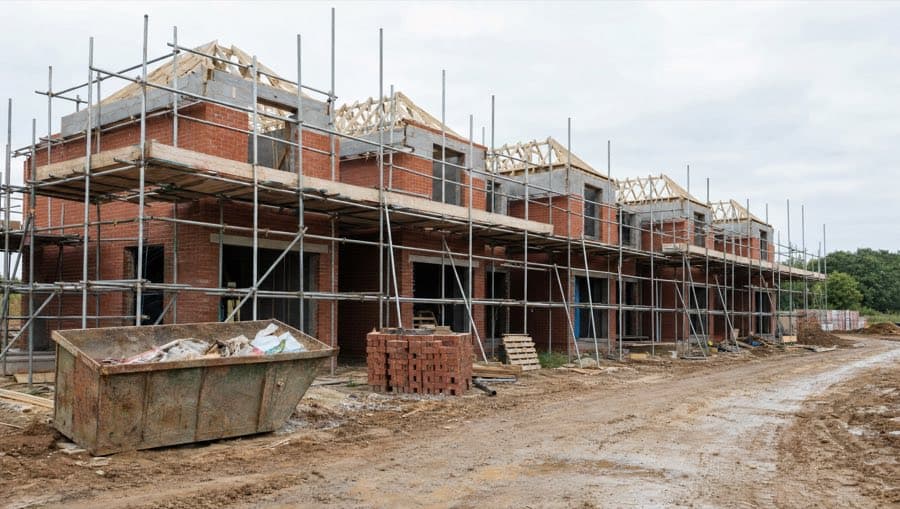
The estates of that era are semis and links with shallow-pitched roofs, a garage to one side and a garden that invites a single-storey rear extension or a two-storey side one. For a rear extension we scaffold the rear elevation with a lift at eaves level for the roofers and bricklayers, and bridge over a conservatory if one is staying. For a two-storey side extension the scaffold returns round the flank, which is usually the tight side, hard against the neighbour's fence. We measure that gap on the survey. See extension and new build scaffolding.
Lofts and re-roofs
Hipped roofs on post-war semis lose usable space, so hip-to-gable and rear-dormer conversions are common. Both need a front and rear lift, a loading bay for the steels and an adaptation when the dormer goes on. Concrete-tiled roofs of the same age are reaching the end of their battens and felt, so re-roofs follow. Edge protection your roofers can work behind, and a temporary roof if the programme cannot wait for the weather. See loft conversion scaffolding and roofing scaffolding.
The High Street conservation area
Rayleigh Conservation Area was designated in 1969 and takes in the High Street, The Mount, Bellingham Lane and the roads off them. The buildings are older, narrower and closer to the kerb than the estates, with shops below and flats above. A scaffold here is usually a front elevation on the pavement with a fan or a protected walkway underneath so the shop stays open. The windmill on Bellingham Lane and the church tower tell you how exposed the top of the hill is, and the wind on the ridge is a factor in sheeting and ties.
Access on the estates
Estate roads are wide enough for the lorry, but the closes and cul-de-sacs off them fill with parked cars during the day. We arrange where the lorry stands and where the materials land before the crew arrives, so the neighbours are not blocked in and your first trade is not waiting.
Highway licences
Rochford District Council is the planning authority for Rayleigh; the roads belong to Essex County Council and licences for scaffolding on the highway are issued through Essex Highways. Most estate jobs sit wholly on the drive or the garden and need no licence. A High Street elevation over the pavement does, and the application lead time goes into the programme at the survey.
Nearby
We cover Leigh-on-Sea and Southend-on-Sea to the south and Basildon to the west. See all areas, or request a survey.