
Scaffolding in Upminster and Rainham
Twincliff puts up scaffolding in Upminster, Cranham and Corbets Tey (RM14) and Rainham and Wennington (RM13), the eastern edge of the London Borough of Havering. A Southend-on-Sea firm, run by a family that has scaffolded in Essex for 40 years, registered in West Horndon, on the Brentwood side of the patch. The person who surveys your job prices it; our own crew erects it and tags it.
Upminster's housing, from a scaffolder's side
Upminster is an inter-war garden suburb. The estate along Hall Lane was laid out on Garden City lines with detached and large semi-detached houses, and smaller terraces south of the railway. Cranham to the east began to build out after the Benyon estate was sold in 1937 and filled in as a commuter suburb after the war. The result is street after street of inter-war semis with hipped roofs and two-storey bays, which is exactly the stock that generates loft conversions and re-roofs.
Loft conversions on 1930s semis
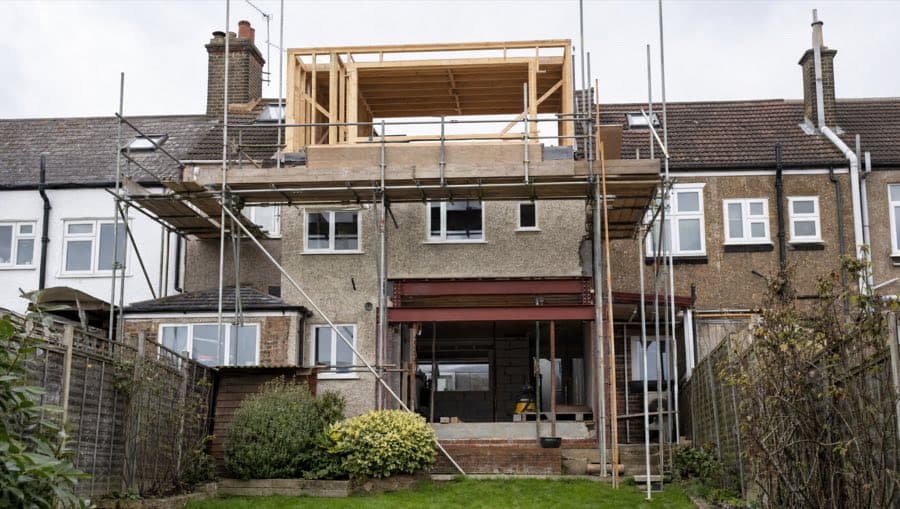
A hipped 1930s semi going to a hip-to-gable with a rear dormer needs a front lift for the gable brickwork, a rear lift for the dormer, and a loading bay for the steels. We put it up before the loft firm strips out, adapt it once the dormer is framed and the roofers need the new eaves, and strike it when the render and windows are in. The tag on the standard tells your crew which stage we are at. See loft conversion scaffolding.
Re-roofs and chimneys
Ninety-year-old roofs on the same semis are coming off: original clay tiles or 1970s concrete replacements, both on felt and battens that are done. A re-roof needs a full perimeter with edge protection your roofers can work behind, and the party chimney stacks that most of these pairs share need a chimney stack scaffold off the roof for repointing or rebuilding. See roofing scaffolding.
Rainham
Rainham has a tight historic core around Rainham Hall, the Norman church of St Helen and St Giles and the Georgian cottages that became the village shops, inside the Rainham conservation area. Around it are wide belts of 1930s and post-war semis and terraces running down towards the marshes, and newer infill. The work is the same as Upminster's, lofts and re-roofs, with the added point that the ground near the marshes is soft and sole boards are not optional.
Conservation areas
Havering has 11 conservation areas. Three are on this patch: Corbets Tey, designated 1990, one of the three medieval settlements that formed Upminster; Cranham, designated 1968, an important group of historic buildings; and Rainham. Upminster's windmill is listed and the tithe barn is a scheduled monument. A scaffold in a conservation area needs no consent of its own, but the streets are narrower and the neighbours closer.
Havering highway licences
Upminster and Rainham are in London, not Essex, for highway purposes. A scaffold on or over the public footway needs a scaffolding and hoarding licence from the London Borough of Havering, handled by its NRSWA team, and the borough inspects licensed scaffolds during their life. Most 1930s semis have a front garden deep enough that the front lift sits on private land and needs no licence. Terraces south of Upminster station and the Rainham village core are on the pavement and do. We tell you which at the survey and build the lead time into the programme.
Access
Suburban avenues are wide enough for the lorry but the side returns between semis are narrow, often a metre or less to the neighbour's fence, and that decides how the flank is scaffolded. Rainham's village streets are tight and busy. We measure both before we price.
Nearby
We cover Brentwood to the north-east and Grays to the south-east. South Ockendon is covered too. See all areas, or request a survey.