
· 7 minute read · Updated
On this page
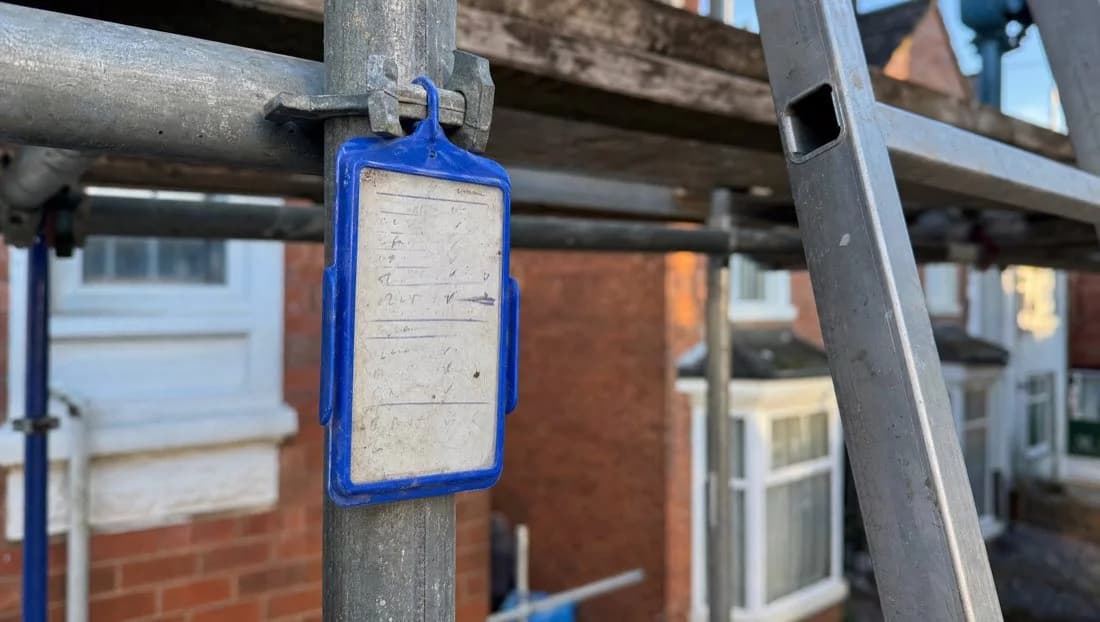
Every scaffold we hand over carries a tag: a holder fixed to a standard at the access point, with a card in it. The card records when the scaffold was last inspected, who inspected it, and that it was found fit for use as built on that date. Here is how to read it, what changes it, and what to do when it is not green.
Where the tag is and what it says
The holder is clipped to a standard at the access point, usually beside the ladder at head height. The card records the date of the inspection, the name or signature of the person who carried it out, which scaffold it refers to, and a statement that the scaffold was inspected and found fit for use as built.
"As built" means as it stood on that date, with the lifts, ties, boards and edge protection that were there then. Ours also carry our number.
Green, red or nothing
The colours are an industry convention, not a rule written in law. Where a tag system is in use, green showing means inspected and found fit for use as built on the date written on it, and a red insert, or a holder with no green insert in it, means do not use: the scaffold is still being built, being altered, has failed an inspection, or has gone past its date.
A scaffold with no tag holder at all is a different case. Tagging is good practice rather than a legal requirement, so an untagged scaffold is not automatically an unsafe or an uninspected one. Ask who inspected it and when, and see the report, before anyone climbs.
What the law asks for is the inspection and the record. Under regulation 12(6) of the Work at Height Regulations 2005 the result of every inspection is recorded and kept until the next one is. The tag is the visible end of that record.
A record, not a promise
The card tells you the scaffold was found fit on the date shown. It does not know what has happened since. A tie taken out to fit a window. A loading bay stacked past its rating. A vehicle clipping the pavement lift. High wind overnight on a seafront elevation. The seven-day inspection interval running out.
The HSE's guidance on scaffolds says a scaffold must be checked whenever it is substantially altered or adversely affected, high winds being the example it gives. Any of those changes the state of the scaffold, whatever colour the card is.
Who inspects, and when
Regulation 12 of the Work at Height Regulations 2005 sets it out. Where the safety of the equipment depends on how it is assembled, it must not be used until it has been inspected in that position (regulation 12(2)). It must be inspected at suitable intervals and each time exceptional circumstances liable to jeopardise its safety have occurred (regulation 12(3)). A working platform used for construction work, from which a person could fall two metres or more, must not be used unless inspected in that position within the previous seven days (regulation 12(4)). "Inspection" means a visual or more rigorous inspection by a competent person (regulation 12(10)).
The regulation places those duties on the employer. The HSE puts it plainly: it is the scaffold user's or hirer's responsibility. On a domestic site, that is usually the contractor running the job.
Our handover inspection and tag cover the erect. We inspect and re-tag after each adaptation we make. The weekly inspections in between belong to the person in control of the work.
What the inspection report records
The tag is a summary. The report is the record. Under regulation 12(7), the inspector writes a report before the end of the working period and gives a copy to the person it was carried out for within 24 hours. Schedule 7 lists its contents: the name and address of the person for whom the inspection was carried out, the location of the work equipment inspected, a description of that equipment, the date and time of the inspection, details of any matter identified that could give rise to a risk to the health or safety of any person, details of any action taken as a result of that matter, details of any further action considered necessary, and the name and position of the person making the report. Under regulation 12(8) it is kept on site until the work is finished, then at an office for three months.
When the card is red, missing or out of date
Do not climb. Do not send anyone else up. Ring the number on the tag.
If the scaffold is ours, we come out, inspect or adapt it, and re-tag it. If it is red because the scaffold is mid-adaptation, wait until the crew has turned it green. A scaffold used before its inspection is a breach of regulation 12(2) for whoever sent the crew up. Never turn the card yourself.
How Twincliff hands over and re-tags
At handover our crew inspects the scaffold against the survey, signs and dates the card, turns the green out and tells the contractor it is ready. The how it works page runs through the five stages.
When the job changes, you ring the number. The card goes red while we work. A hop-up for the fascia, a loading bay for the steels, a top lift for the dormer on a loft conversion: each is re-inspected and re-tagged before your crew goes back on. Nobody but our crew alters the scaffold. Same number start to finish, from a terrace in Southend-on-Sea to a small development.
Homeowners: the scaffold outside your house
Look for four things. A holder on an upright near the ladder. A card in it. Green showing, with a date within the last seven days while anyone is working off it. A phone number. If the card is red, your builder should not have anyone on it. If there is no tag at all, ask your builder who erected it and who is doing the weekly inspection. There is more on the domestic scaffolding page.