
Scaffolding in Hockley, Hullbridge and Rochford
Twincliff puts up scaffolding across SS5 and SS4: Hockley, Hawkwell, Hullbridge, Rochford and Ashingdon. A Southend-on-Sea firm, run by a family that has scaffolded in Essex for 40 years. Rochford is three miles north of Southend. The person who surveys your job prices it. Our own crew erects it and tags it.
Railway villages that filled up after the war
Hockley and Rochford stations opened on the same day, 1 October 1889, on the line to Southend Victoria. Most of the housing came later. Hockley and Hawkwell now run together as one built-up area of about 15,000 people. Hullbridge was plotland holiday homes from 1929, when High Elms farm was sold off, and became its own parish in 1964.
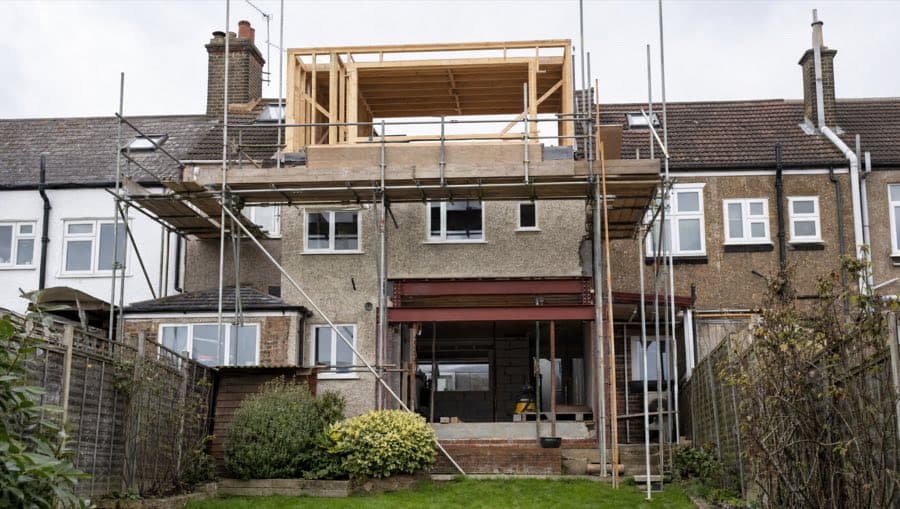
That gives a scaffolder three kinds of house. Inter-war semis and bungalows along the main roads. Post-war and 1980s estate houses in the closes behind them. And the old plotland bungalows of Hullbridge, many rebuilt or extended since. The estate houses are the extension and loft trade now: hip-to-gables, rear dormers, two-storey side extensions. A hipped semi going to a dormer needs a front and rear lift and a loading bay for the steels. See loft conversion scaffolding and extension and new build scaffolding.
Hockley's hill and its woods
Hockley's centre is a linear one that climbs from the station up Spa Road to the junction with Main Road and Southend Road, and the houses off it follow the slope. Hockley Woods, over 130 hectares and, in the council's words, the largest remaining area of the wild wood that covered Essex after the Ice Age, sits on the south side, so plots backing onto it have trees close to the rear elevation and no rear access except through the house. We set the base to the slope and plan the rear lift around the trees at the survey.
Hullbridge and the Crouch
Hullbridge's northern edge is the River Crouch, and the low ground along Lower Road and Watery Lane is flagged for flood risk in the district's own reports. Riverside plots take the wind off the water and the ground is wet: sole boards under every standard, sheeting and netting decided at the survey.
Rochford's conservation area
Rochford is a market town founded in 1257 and centred on a crossroads. Its conservation area, designated in 1969 and extended since, covers the historic core: brick and weatherboarded buildings of eighteenth- and nineteenth-century appearance, brick town houses in South Street and the east end of West Street, and rows of one-and-a-half storey cottages along West Street and North Street. The council's own appraisal says no other Essex town keeps so many cottages of that type. They are low, the pavements narrow, the parking on-street. A weatherboarded cottage front needs a light footprint, a pavement licence and a start date built around it. A scaffold in a conservation area does not need extra consent in itself, but the work behind it usually does.
Planning and the highway
Rochford District Council is the planning authority for all of SS4 and SS5 and has ten conservation areas in all. The roads belong to Essex County Council, and any scaffold standing on or over the public highway needs a licence through Essex Highways. Only the scaffolding contractor may apply, so we do; Essex Highways takes 15 working days from receipt to process it, the licence is valid for two weeks from the date of issue and can be applied for initially for up to 26 weeks, and a renewal takes three working days from receipt. Most estate houses have a drive, so the scaffold sits inside the boundary. Rochford's streets and the Spa Road parades do not.
Who signs on to our scaffolds here
Loft firms, roofers, builders on extensions, renderers and decorators, and homeowners whose builder has said "sort the scaffold". The tag on the standard is our word that the scaffold was safe on the date of inspection. One number, start to finish.
Nearby
We cover Rayleigh to the west and Southend-on-Sea to the south. See all areas, or request a survey.
Ring 07490 092490, WhatsApp the same number, or fill in the survey card.