Scaffolding on Canvey Island
Twincliff puts up scaffolding across Canvey Island, postcode SS8, from the seafront to the estates behind the sea wall. A Southend-on-Sea firm, run by a family that has scaffolded in Essex for 40 years, a short run back over Canvey Way. The person who surveys your job prices it. Our own crew erects it and tags it.
An island below the tide
Canvey is reclaimed marsh. Dutch workers walled it in 1622, and two of their octagonal cottages still stand: one of 1618 on Canvey Road, now the museum, and one of 1621 in Haven Road. The island lies about ten feet below mean high water. On the night of 31 January 1953 the sea came over the walls and 58 people died, many of them in single-storey holiday bungalows. The walls were rebuilt, then replaced by the present concrete sea wall in the 1970s and 80s, 15 miles of it, and the whole island still sits in Flood Zone 3.
For a scaffolder that history means two things. The ground is alluvium, silt laid down by the Thames over London Clay. It is soft and it moves, so sole boards are not optional here: every standard goes on a base plate on timber, and we look at the base again at the first inspection, because a leg that has settled shows then. And the housing is low.
Bungalows and chalets
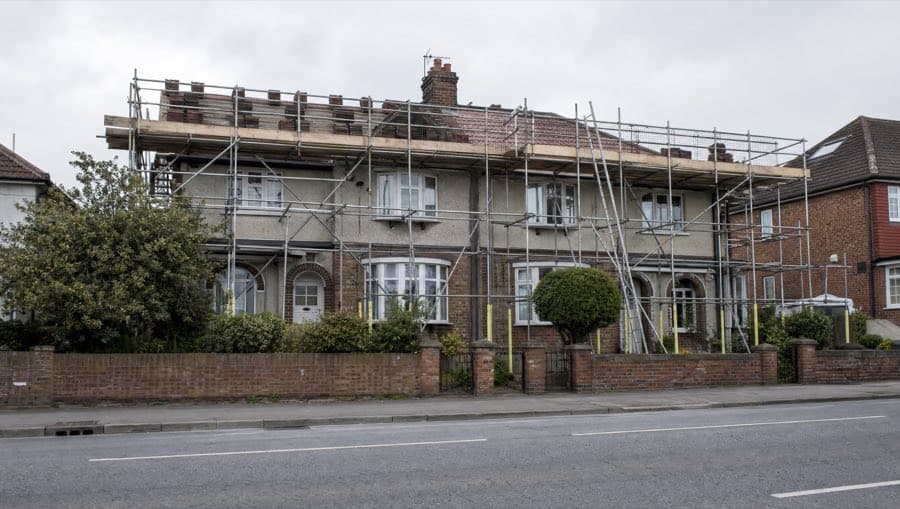
A large share of Canvey's houses are bungalows and chalet bungalows. Castle Point's population is older than the national average, and several of its estates were laid out as seaside places to retire to. A bungalow re-roof looks small and is not. The eaves are low, so a single lift with edge protection does the roof, but the hip lengths are long and a loading bay for the tiles saves your roofers carrying every pack up a ladder. Chalet dormers, chimney stacks on the ridge, and the fascia, gutter and render repairs that go with them are the everyday jobs. A chalet going to a proper dormer is the usual loft job. See roofing scaffolding and domestic scaffolding.
Wind off the estuary
The seafront from Thorney Bay to Canvey Point is open to the Thames estuary and the whole island is flat, so nothing slows the wind before it reaches a scaffold. Debris netting and sheeting add sail area. On Canvey we decide the tie pattern and the netting at the survey, not on the day, and we would rather leave a run unsheeted than sheet it and under-tie it. Salt air works on tube and fittings, which is one reason we inspect on a set cycle and re-tag, not only at handover.
Two roads on and off
There are two road links to the island: Canvey Way, the A130, and Canvey Road, the B1014, both over bridges. A delivery timed against the morning queue costs your crew half a day, so we load for Canvey the night before and cross early. Benfleet station has its own Canvey entrance, but tube and boards come by road.
Planning and the highway
Castle Point Borough Council is the planning authority for Canvey Island. The roads belong to Essex County Council, and any scaffold standing on or over the public highway needs a licence through Essex Highways. Only the scaffolding contractor may apply, so we do; Essex Highways takes 15 working days from receipt to process it, the licence is valid for two weeks from the date of issue and can be applied for initially for up to 26 weeks, and a renewal takes three working days from receipt. On a pavement-fronted parade the licence date sets the start date. Structures wholly on private land do not need one, and most Canvey plots have a drive and a front garden, so most domestic scaffolds sit inside the boundary. We tell you which at the survey.
Who signs on to our scaffolds here
Roofers, renderers, fascia and window firms, builders on rear extensions and chalet conversions, and the homeowner whose builder has said "sort the scaffold". The tag on the standard is our word that the scaffold was safe on the date of inspection. One number, start to finish.
Nearby
We cover Leigh-on-Sea to the east and Basildon to the west. Benfleet, Hadleigh and Thundersley are covered too. See all areas, or request a survey.
Ring 07490 092490, WhatsApp the same number, or fill in the survey card.